
When and How to Harvest Macadamia Nuts
We’ve already discussed how to grow and care for the two types of edible macadamia, the smooth-shelled Queensland variety, M. integrifolia, and the rough-shelled M. tetraphylla. Native to Australia, they grow well in home gardens in USDA Hardiness Zones 9 to 11. In this guide, we focus on.
We’ve already discussed how to grow and care for the two types of edible macadamia, the smooth-shelled Queensland variety, M. integrifolia, and the rough-shelled M. tetraphylla.
Native to Australia, they grow well in home gardens in USDA Hardiness Zones 9 to 11.
In this guide, we focus on harvesting. You will learn when nuts ripen, what they look like, and how to gather your crop. Here’s what’s to come:
What You Will Learn
- Forbearance and Fruit Formation
- Signs that Signal Readiness
- Reaping the Rewards
- Making the Most of Macadamia
Let’s get started!
Forbearance and Fruit Formation
Macadamia cultivation generally begins with a vegetatively propagated plant from a reputable nursery.
The average cultivar lives from 40 to 60 years. It begins to set fruit at six or seven years old. By the age of 10 or so, it reaches maturity and produces a 30- to 50- pound yield. Over the course of its life, the yield generally increases.
But prepare to be amazed, because some remarkable statistics have been documented. One tree in Coronado, California produced 270 pounds of nuts in one year, and another in Queensland, Australia is still alive at the ripe old age of 140.
That’s a long time, and a lot of nuts, so let’s find out when and how to harvest them all!
Signs that Signal Readiness
The fruiting season for macadamia begins in late autumn and continues through spring. The time to ripen varies by cultivar, but all varieties bear fruit continuously during their fruiting period, as opposed to all at once.
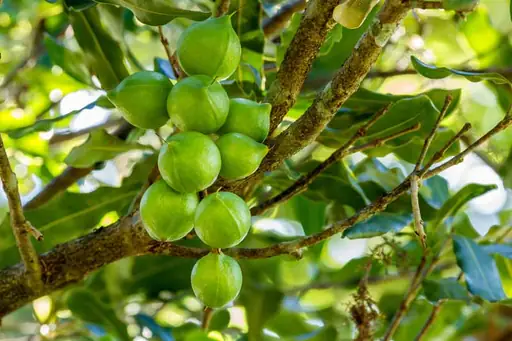
It’s not hard to tell when macadamias are ripe. Their husks begin to dry out, lose their tackiness, and gradually change from bright green to brown. They shrink and split open, their split edges turn brown, and the brown nut inside becomes visible.
There are varieties like ‘Cate,’ ‘James,’ and ‘Vista’ that “self-harvest,” and drop ripe fruit. This makes the job easy. Some people like to leave a tarp under them to collect their crop. I’m not a fan, as it may gather rainwater, rot your harvest, and damage the lawn below.
Instead, visit the tree or trees each day to reap what has dropped. Be sure to remove all fallen fruit, to keep hungry rodents away. Once gathered, remove the husks. Evaluate the shells within, and discard any that look moldy or damaged.
You may be tempted to shake the tree to loosen nuts, but don’t. Macadamia branches are on the brittle side, and you may injure them. In addition, unripe nuts may fall.
For cultivars that don’t drop fruit, you’ll need to judge their readiness.
If they appear as described, place a tarp temporarily beneath the tree. Use a long pole to gently tap the branches (no shaking) and release ripe nuts. Some branches may bear a single fruit, while others may hold multiples in clusters.
When you’re through, put the tarp away for next time.
You could use a fruit-picking tool with a basket on the end, but I don’t recommend it. You may inadvertently catch it on unripe fruit, causing it to fall.
Reaping the Rewards
When a beautiful tree like the macadamia produces an abundance of nuts, it’s truly a sight to behold – and a mess to clean up!
Take the bending out of gathering your harvest with useful tools, such as the Garden Weasel Large Nut Gatherer. Simply roll it along to gather your crop and slide the wire cage spreader to release it.
The handle is carbon steel welded with a comfort hand grip, and the wire cage is made of tempered steel. A lifetime warranty is included.
Or, go all out with Bag-A-Nut’s 18-inch Push Harvester. Sweep your crop up as you push, collecting it in a removable basket.
It’s made in the USA and manufactured using 30 percent pre-consumer recycled plastic.
Gather your harvest often, especially in damp weather, so it doesn’t rot or attract rodents.
Each time you collect a fresh batch, remove the husks immediately. Place the brown-shell nuts on wire racks in a cool, dry place to dry out for two to three weeks. As they dry, the nutmeats, or kernels, shrink away from the shell, and will come out easily when cracked.
Macadamia shells are very hard to crack, so be prepared to do the job with a hammer or vise. Use kernels immediately, store, or freeze.
Making the Most of Macadamia
Knowing when and how to harvest will go a long way toward optimal results.
To recap, macadamias are ready to harvest when:
- They reach about 1 inch in diameter.
- Green husks begin to turn brown, shrink, and split.
- Split husks show brown edges.
- Brown shells are visible inside split husks.
- Husks feel dry to the touch, not tacky.
- “Self-harvesting” fruit begins to fall to the ground.
And remember to:
- Harvest often.
- Pick up promptly.
- Remove husks immediately after harvest.
- Dry kernels in-shell for two to three weeks before using, storing, or freezing.
- Discard husks or shells that look moldy, damaged, or unripe.
A macadamia tree isn’t just another pretty face in the landscape. When it reaches maturity, it yields an abundance of sweet, creamy nuts that demand a king’s ransom on the market today.
If you’re in USDA Hardiness Zones 9 to 11, I truly envy you! I can only imagine being able to go out to the backyard to get fresh nuts for holiday baking.
Please read our previous article, “How to Grow and Care for a Macadamia Nut Tree,” for all you need to know about topics including growing, maintaining, cultivar selection, pests and disease, storage, and recipes. Then schedule a trip to your local nursery to choose a new edible addition to your property!
- Facebook48
- X

问题与讨论