
Esta página é exibida em seu idioma original. A tradução ainda não está disponível.
A seleção Seedsun
Viola walteri
SKU: VIOL-WALT-01G
A native violet grown as much for the leaf as the flower. Viola walteri, Walter's violet, belongs to the violet family, Violaceae, and honors the British-born botanist Thomas Walter, whose Flora Caroliniana of 1788 was the first flora of the American Southeast. The prostrate blue violet ranges in.
Solicite um orçamento personalizado.
Os preços, tamanhos das embalagens e disponibilidade serão confirmados em seu orçamento personalizado. O envio de uma consulta não implica na efetivação de um pedido pago.
Informe-se sobre a adequação, o período de semeadura e os requisitos de cultivo.
Confirme as opções de entrega e os documentos necessários em seu orçamento.
Sobre esta variedade
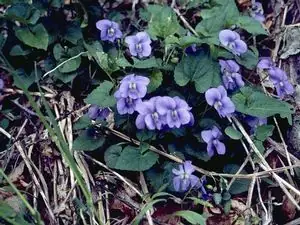
A native violet grown as much for the leaf as the flower. Viola walteri, Walter's violet, belongs to the violet family, Violaceae, and honors the British-born botanist Thomas Walter, whose Flora Caroliniana of 1788 was the first flora of the American Southeast. The prostrate blue violet ranges in the wild from Texas east to Florida and north to Virginia and Ohio, threading the floors of moist deciduous woodlands and shaded rocky ledges.
The foliage is the quiet charm. Heart-shaped leaves, silvered and softly veined above, carry a deep purple flush on the undersides, and the low, creeping stems root as they run to knit a dense, even mat only a few inches tall. Partly evergreen through mild winters, the leaves hold color when most groundcovers have retreated.
In early spring, small lavender-blue flowers rise just above the mat, a soft seasonal contrast to the patterned leaves. Like other violets, Walter's violet serves as a larval host for fritillary butterflies, whose caterpillars feed on the foliage, so a planting earns a place in the wildlife garden as well as the ornamental one.
Set the prostrate blue violet as a shade groundcover along a woodland path, at the front of a shaded border, between stepping stones, or woven among ferns, wild ginger, and other shade companions in moist, well-drained soil. The creeping habit fills in steadily without overwhelming neighbors, and the purple-backed foliage reads beautifully at close range. A refined native for the shaded garden.
Há muito mais para descobrir.
Perguntas e discussão